On 27 Oct 2014, HKSS helped organize the tour of Anderson Road Quarry for students who majored in Environmental Management for Business from the Hong Kong Polytechnic University. The students learnt about the quarrying industry in HK, the development history of Anderson Road Quarry and the rehabilitation management of the quarry site.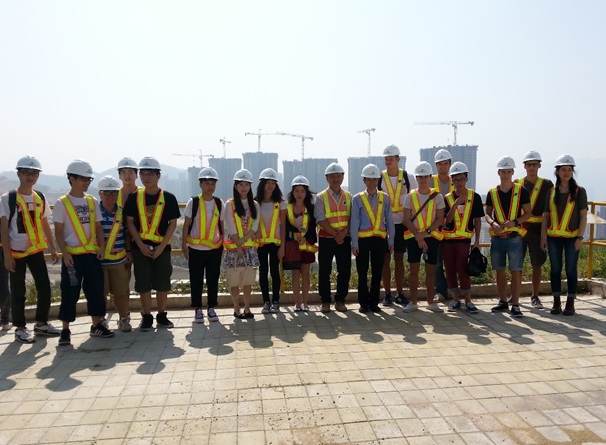
Students visited the quarry site and witnessed the construction situation of it.
During the tour, students were most impressed by realizing how the rehabilitation works have transformed the Quarry to become a fully-integrated environmental-friendly enterprise. The Anderson Road Quarry, which has been in operation since 1956 was identified as an area of degraded landscape requiring rehabilitation in 1989. The rehabilitation works, due to be completed in mid-2016, will provide a new landform consisting of benches and slopes on rock face, and a platform of approximately 40 ha for development.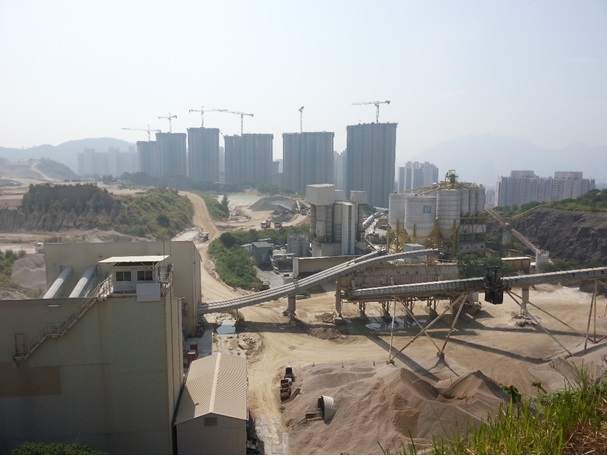
The rehabilitation works are in process and supposed to be completed in mid-2016.
Students then directed their attention on the sustainable development policies adopted by the Quarry. One of the land use principles formulated for the quarry site is to create a green sustainable and pedestrian-friendly environment. The future development would aim at providing a green and sustainable environment that complements the natural landscape of Tai Sheung Tok to the north/northeast, and the urban character with dense housing development to the south/southwest. The use of public transport would be encouraged, and a pedestrian-friendly environment would be created.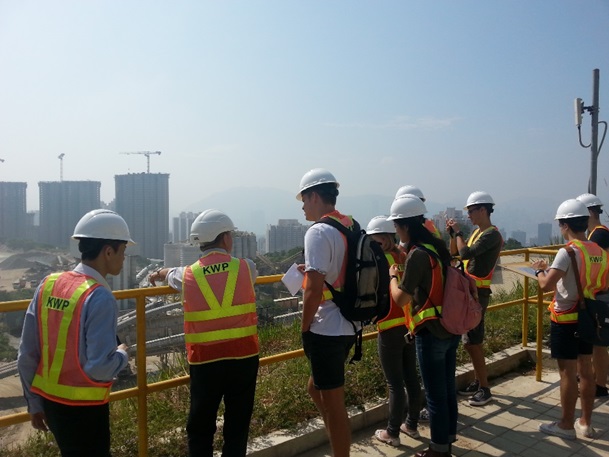
Students were particularly interested in the environmental practices adopted by the Quarry.
At present the site formation works, road works and other infrastructure provisions are proved to be a pleasant and successful cooperation between the quarry and the Hong Kong government in innovative rehabilitation. Under the concept of environmental protection and sustainable development, this large piece of land would predictably be utilized and developed correspondingly not only to meet the housing demand – it would be able to hold nearly 50,000 residents – but also to explore economic and recreational opportunities and other development opportunities as well.